


 Kaw Oumar Sarr
will affact the Abraham Accords economic development. By Samuel Shay, Entrepreneur and Senior Economic Advisor to the Abraham Accords
 The Middle East may be approaching one of the most consequential turning points in its modern history. For nearly five decades, the Iranian regime has operated under an ideological framework rooted in confrontation, regional proxy influence, and strategic hostility toward Israel and several Gulf states. A structural political transformation in Tehran would not simply represent a domestic Iranian shift. It could redefine the entire geopolitical and economic architecture of the region.
The question is no longer limited to security. It is fundamentally about economic realignment, regional integration, and long term prosperity under the framework of the Abraham Accords.
From Confrontation to Integration
For decades, the ruling establishment in Iran prioritized ideological expansion and military projection over economic cooperation. This strategy positioned Iran outside emerging regional economic frameworks and placed it in direct opposition to Israel and key Gulf states.
However, a new Iranian leadership oriented toward stability, trade, and modernization would fundamentally alter this equation. Instead of acting as a destabilizing force, Iran could become one of the most influential economic engines in the Middle East.
Iran is not a marginal economy. It possesses vast natural gas and oil reserves, a population exceeding 80 million, advanced industrial infrastructure, and a highly educated society with strong scientific and technological capabilities. Integrated into the Abraham Accords framework, Iran would immediately shift from being a strategic threat to becoming a strategic asset.
Historical Foundations for Renewed Cooperation
It is important to remember that relations between Iran and Israel were once cooperative and pragmatic. Prior to 1979, trade, intelligence coordination, and strategic dialogue were active and constructive. Economic exchanges included energy cooperation and infrastructure coordination.
A post ideological Iran could revive pragmatic state to state engagement based on mutual economic interests rather than ideological confrontation. Such a shift would not be unprecedented. It would represent a return to a model that previously existed and functioned effectively.
Strategic Implications for the Abraham Accords
The Abraham Accords were designed not merely as diplomatic agreements but as an economic transformation platform connecting Israel with Gulf and regional partners. If Iran were to join this framework under new leadership, the consequences would be profound:
Energy Integration: Iran’s energy reserves could be integrated into regional export corridors linking the Gulf, the Eastern Mediterranean, Europe, and Asia.
Trade Corridors: A land bridge connecting Asia through Iran to the Gulf, Israel, and onward to Europe could dramatically reduce transport costs and strengthen supply chains.
Technology Partnerships: Iranian scientific and engineering talent could collaborate with Israeli innovation ecosystems and Gulf capital markets.
Security Stabilization: Reduced proxy conflict would significantly lower sovereign risk premiums, unlocking large scale foreign direct investment across the region.
The transformation would extend from South Asia to the Mediterranean, from the Gulf to Africa, and into European markets.
Economic Multiplier Effect Across the Region
The Middle East has historically diverted enormous resources toward military expenditures due to persistent instability. A stabilized and integrated Iran within the Abraham Accords architecture would trigger a powerful multiplier effect:
Accelerated infrastructure development
Expanded logistics hubs across the Gulf and Levant
Increased capital mobility
Growth in renewable energy, water desalination, advanced agriculture, and digital economy sectors
Such integration would position the Middle East as a central node in global commerce rather than a geopolitical fault line.
Impact on Poverty and Regional Development
One of the most overlooked aspects of regional instability is its economic cost. Chronic conflict suppresses job creation, discourages international investment, and widens inequality.
A cooperative framework that includes Iran could:
Expand employment across industrial and technological sectors
Increase cross border trade
Enhance food and energy security
Support large scale development initiatives across emerging markets
This would not be symbolic normalization. It would represent structural economic transformation.
A Global Strategic Shift
If Iran were to formally join the Abraham Accords under a pragmatic and development oriented government, the geopolitical implications would extend beyond the Middle East. We would likely witness:
Stronger Asia Gulf Europe connectivity
Expanded cooperation between Israel and major Asian economies
Increased African integration into regional supply chains
Strategic infrastructure investments backed by Gulf sovereign wealth funds
The Middle East would move from fragmentation to coordinated growth.
About the Author
Samuel Shay is an entrepreneur and Senior Economic Advisor to the Abraham Accords. He has been actively involved in advancing regional economic cooperation initiatives, cross border investment frameworks, and strategic development projects linking Israel with Gulf states, Asia, and emerging markets. His work focuses on transforming geopolitical breakthroughs into sustainable economic growth platforms across the Middle East and beyond.
The coming period may define whether the region remains trapped in cycles of confrontation or steps into an era of integrated prosperity. A transformed Iran aligned with the Abraham Accords would not only reshape regional politics. It would unlock one of the most significant economic opportunities of the 21st century.
Nouvel ordre mondial : Comment les changements en Iran influenceront le développement économique des Accords d'Abraham.
Par Samuel Shay, entrepreneur et conseiller économique principal des Accords d'Abraham.
Le Moyen-Orient pourrait être à l'aube d'un tournant majeur de son histoire moderne. Depuis près de cinquante ans, le régime iranien fonctionne selon un cadre idéologique fondé sur la confrontation, l'influence régionale par procuration et une hostilité stratégique envers Israël et plusieurs États du Golfe. Une transformation politique structurelle à Téhéran ne se limiterait pas à un simple changement de politique intérieure iranienne. Elle pourrait redéfinir l'ensemble de l'architecture géopolitique et économique de la région.
La question ne se limite plus à la sécurité. Il s'agit fondamentalement d'un réalignement économique, d'une intégration régionale et d'une prospérité durable dans le cadre des Accords d'Abraham.
De la confrontation à l'intégration
Pendant des décennies, le pouvoir en place en Iran a privilégié l'expansion idéologique et la projection militaire à la coopération économique. Cette stratégie a marginalisé l'Iran au sein des nouveaux cadres économiques régionaux et l'a placé en opposition directe avec Israël et les principaux États du Golfe.
Cependant, une nouvelle direction iranienne, axée sur la stabilité, le commerce et la modernisation, modifierait radicalement cet équilibre. Au lieu d'être une force déstabilisatrice, l'Iran pourrait devenir l'un des moteurs économiques les plus influents du Moyen-Orient.
L'Iran n'est pas une économie marginale. Le pays possède d'immenses réserves de gaz naturel et de pétrole, une population de plus de 80 millions d'habitants, des infrastructures industrielles de pointe et une société très instruite dotée de solides capacités scientifiques et technologiques. Intégré au cadre des accords d'Abraham, l'Iran passerait immédiatement du statut de menace stratégique à celui d'atout stratégique.Historical Foundations for Coopération renouvelée
Il est important de rappeler que les relations entre l'Iran et Israël étaient autrefois empreintes de coopération et de pragmatisme. Avant 1979, les échanges commerciaux, la coordination des renseignements et le dialogue stratégique étaient actifs et constructifs. Les échanges économiques comprenaient la coopération énergétique et la coordination des infrastructures.
Un Iran libéré des influences idéologiques pourrait renouer avec un engagement pragmatique entre États, fondé sur des intérêts économiques mutuels plutôt que sur une confrontation idéologique. Un tel changement ne serait pas sans précédent. Il représenterait un retour à un modèle qui a existé et fonctionné efficacement par le passé.
Implications stratégiques des accords d'Abraham
Les accords d'Abraham n'étaient pas de simples accords diplomatiques, mais une véritable plateforme de transformation économique reliant Israël à ses partenaires du Golfe et de la région. Si l'Iran rejoignait ce cadre sous une nouvelle direction, les conséquences seraient profondes :
1. Intégration énergétique : Les réserves énergétiques iraniennes pourraient être intégrées aux corridors d'exportation régionaux reliant le Golfe, la Méditerranée orientale, l'Europe et l'Asie.
2. Corridors commerciaux : Un corridor terrestre reliant l'Asie, via l'Iran, au Golfe, à Israël et à l'Europe pourrait réduire considérablement les coûts de transport et renforcer les chaînes d'approvisionnement.
3. Partenariats technologiques : Les talents scientifiques et d'ingénierie iraniens pourraient collaborer avec les écosystèmes d'innovation israéliens et les marchés de capitaux du Golfe.
4. Stabilisation sécuritaire : La réduction des conflits par procuration diminuerait significativement les primes de risque souverain, favorisant ainsi des investissements directs étrangers massifs dans toute la région.
Cette transformation s'étendrait de l'Asie du Sud à la Méditerranée, du Golfe à l'Afrique, et jusqu'aux marchés européens.
Effet multiplicateur économique régional
Historiquement, le Moyen-Orient a consacré d'énormes ressources aux dépenses militaires en raison d'une instabilité persistante. Un Iran stabilisé et intégré dans le cadre des accords d'Abraham engendrerait un puissant effet multiplicateur :
• Accélération du développement des infrastructures
• Expansion des plateformes logistiques dans le Golfe et au Levant
• Amélioration de la mobilité des capitaux
• Croissance des secteurs des énergies renouvelables, du dessalement de l'eau, de l'agriculture de pointe et de l'économie numérique
Une telle intégration positionnerait le Moyen-Orient comme un nœud central du commerce mondial plutôt que comme une zone de fracture géopolitique.
Impact sur la pauvreté et le développement régional
L'un des aspects les plus négligés de l'instabilité régionale est son coût économique. Les conflits chroniques freinent la création d'emplois, découragent les investissements internationaux et creusent les inégalités.
Un cadre de coopération incluant l'Iran pourrait :
• Développer l'emploi dans les secteurs industriels et technologiques
• Accroître le commerce transfrontalier
• Renforcer la sécurité alimentaire et énergétique
• Soutenir des initiatives de développement à grande échelle dans les marchés émergents
Il ne s'agirait pas d'une normalisation symbolique, mais d'une véritable transformation structurelle de l'économie.
Un tournant stratégique mondial
Si l'Iran adhérait formellement aux Accords d'Abraham sous un gouvernement pragmatique et tourné vers le développement, les implications géopolitiques dépasseraient largement le Moyen-Orient. Nous assisterions probablement à :
• Un renforcement des liens entre l'Asie, le Golfe et l'Europe
• Un élargissement de la coopération entre Israël et les principales économies asiatiques
• Une intégration accrue de l'Afrique dans les chaînes d'approvisionnement régionales
• Des investissements stratégiques dans les infrastructures, soutenus par les fonds souverains du Golfe
Le Moyen-Orient passerait d'une situation de fragmentation à une croissance coordonnée.
À propos de l'auteur
Samuel Shay est entrepreneur et conseiller économique principal auprès des Accords d'Abraham. Il participe activement à la promotion d'initiatives de coopération économique régionale, de cadres d'investissement transfrontaliers et de projets de développement stratégiques reliant Israël aux États du Golfe, à l'Asie et aux marchés émergents. Son travail vise à transformer les avancées géopolitiques en plateformes de croissance économique durable au Moyen-Orient et au-delà.
La période à venir sera déterminante pour savoir si la région restera engluée dans des cycles de confrontation ou si elle entrera dans une ère de prospérité intégrée. Un Iran transformé, aligné sur les Accords d'Abraham, ne se contenterait pas de remodeler la politique régionale.
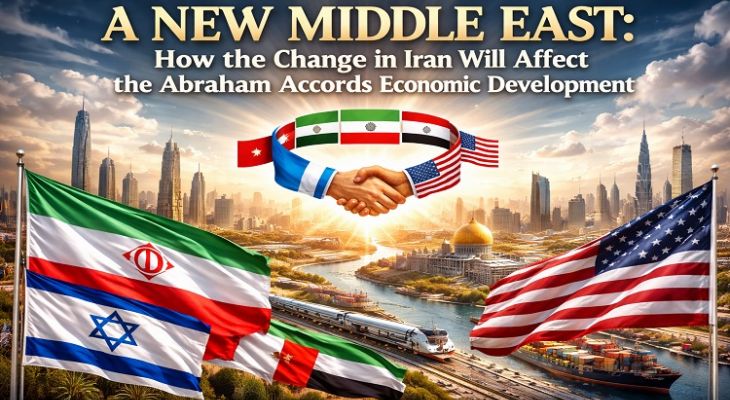
Il ouvrirait également la voie à l'une des opportunités économiques les plus importantes du XXIe siècle.
Le partage de l'info